






Whether you tune into the nightly news or peruse online economics columns, you've almost certainly heard the term "inflation." But what does it mean and how does it impact your personal finances and the economy as a whole? Let's learn more about what inflation is and its impacts.
Inflation: A Guide for Beginners
Inflation is a term that is used in consumer economics frequently, but do you really know what it means? We offer insight here.
What is inflation?
According to the central bank of America, The Federal Reserve, inflation is when the prices of goods and services increase over time. As a result, consumers often see their purchasing power decline in tandem with a rise in inflation. Experts express inflation as a percentage and there are several ways that it is measured. Here are two of the most common measurements used by economists:
- Consumer Price Index (CPI): The index measures the price change an average consumer will pay for necessary goods and services. This may include transportation, health services or food.
- The Wholesale Price Index (WPI): This measurement considers the price of items or products before they make it to the retail market.
Remember that inflation becomes evident over time but adjusts slightly in response to external factors. The U.S. Bureau of Labor Statistics officially measures the CPI and is the most reliable source to determine the current inflation rate.
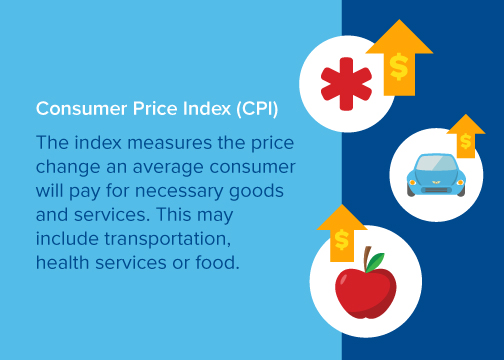 Understanding CPI is key to navigating inflation.
Understanding CPI is key to navigating inflation.
How is inflation controlled?
Inflation is normally the result of the money supply outpacing the economy's growth at the same time. The Federal Reserve reports that an acceptable inflation rate is around 2%. However, rising inflation rates can damage the nation's economy. Because of this, The Federal Reserve and the Federal Open Market Committee (FOMC) can try to control inflation with their monetary policy. The FOMC is a group of 12 experts who meet eight times yearly to support price stability and economic growth.
The FOMC's monetary policy can be one of the main ways that inflation is controlled. The Committee also has the power to take emergency action in times of extreme economic stress by keeping a low inflation rate or bond-buying activity.
Why does inflation matter to you?
The inflation rate is one of the most valuable measures of economic activity, and average Americans can often feel the results of it in their everyday lives. Inflation impacts consumers in several important ways. Here are two of the most unique ways that high inflation can affect you:
- Weak purchasing power: When inflation rises, the amount of money a consumer needs to pay for goods and services will also increase. While purchasing power weakens over a lifetime regardless, inflation compounds the loss of value that the dollar has.
- Interest rates: To deal with rising inflation, policymakers may increase interest rates to better control the money supply in the economy.
If you are interested in learning more about how the inflation rate may affect your financial circumstances, reach out to a Vectra Bank professional today.
Content is offered for informational purposes only and should not be construed as tax, legal, financial or business advice. Please contact a professional about your specific needs and advice. Content may contain trademarks or trade names owned by parties who are not affiliated with Zions Bancorporation, N.A. Use of such marks does not imply any sponsorship by or affiliation with third parties, and Zions Bancorporation, N.A. does not claim any ownership of or make representations about products and services offered under or associated with such marks.